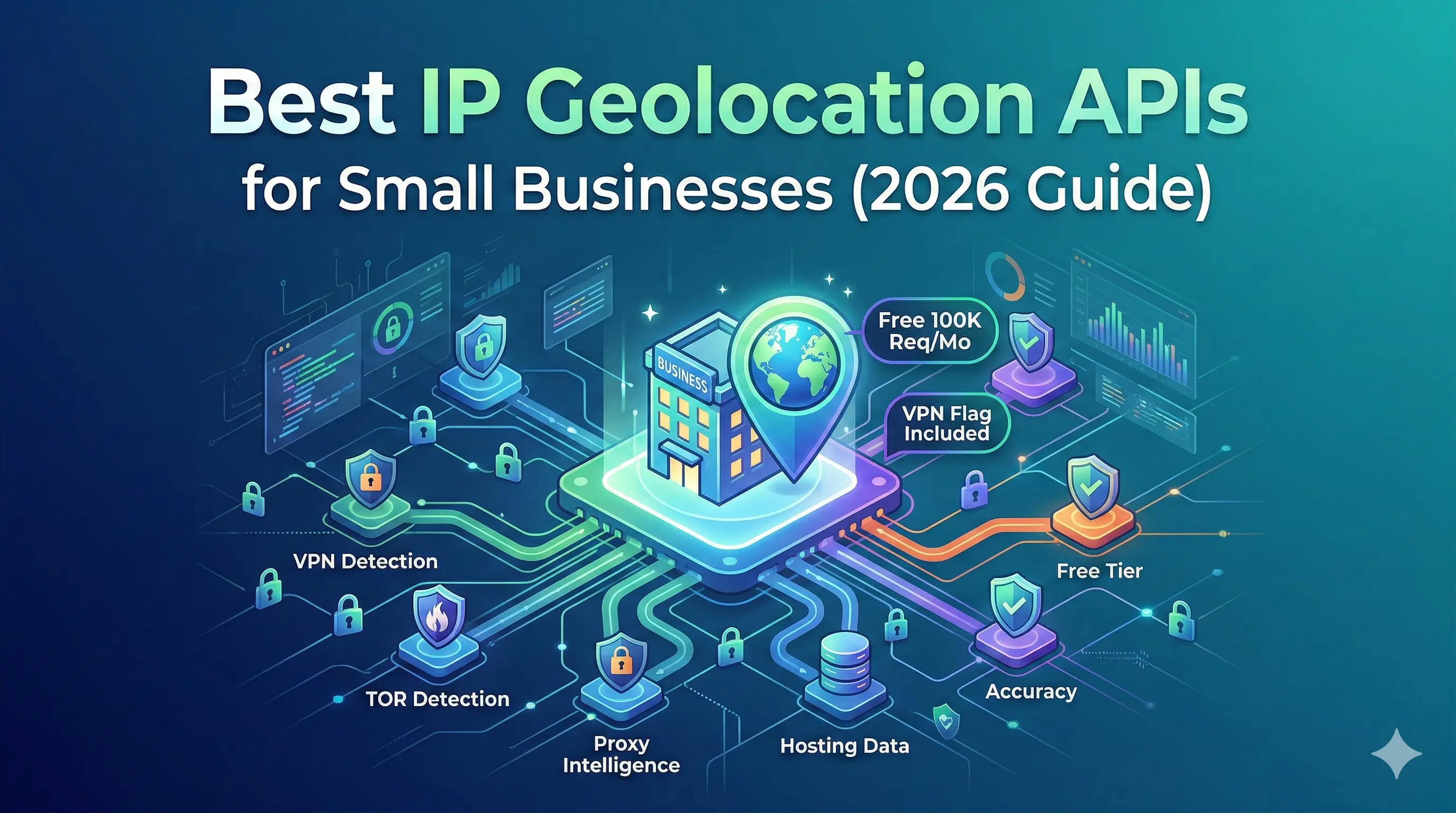
Best IP Geolocation APIs for Small Businesses (2026 Guide)
As a backend engineer or SaaS founder in 2026, you're likely navigating an increasingly complex digital landscape. User personalization is no longer optional, fraud is sophisticated, and compliance regulations are tight. While knowing a user's location based on their IP address has always been useful, IP geolocation has evolved far beyond simple country lookups. It's now a crucial component of security intelligence, enabling you to defend against automated attacks, enhance user experience, and make data-driven decisions.
For small businesses and bootstrapped startups, choosing the right IP geolocation API is a balancing act. You need reliable, accurate data and advanced security intelligence, but you also need to manage costs. This guide will cut through the noise, analyzing the best IP geolocation APIs available in 2026, with a strong focus on practical, real-world application for small-scale operations.
Why IP Geolocation Matters in 2026?
The use cases for IP intelligence are vast and impactful:
-
Fraud Prevention: This is arguably the most critical application. Detecting if a user's IP is from a known VPN, proxy, TOR node, or hosting provider is essential. It's the first line of defense against account takeovers, fraudulent purchases, and synthetic identity creation.
-
Advanced Rate Limiting: While standard rate limiting works by IP, smart rate limiting can be more sophisticated. You can apply different limits based on the Autonomous System Number (ASN) or network type. For example, you might be more restrictive for traffic originating from hosting data centers (often bot traffic) compared to residential ISPs.
-
Personalization & UX: Tailor user experience by automatically setting the language, currency, or showing location-specific content. This can improve conversion rates and user satisfaction.
-
Compliance: Ensure you're not serving users from legally restricted jurisdictions (e.g., countries under US sanctions or non-compliant with local data regulations).
-
Analytics: Gain deeper insight into your user base by understanding where your traffic is coming from, allowing for better-informed marketing and product decisions.
What Small Businesses Should Look for in an IP Geolocation API?
A successful integration hinges on several key technical and business factors:
1. Accuracy and Granularity
The API must provide accurate data, from the country down to the city level. In 2026, accurate ASN (Autonomous System Number) and ISP (Internet Service Provider) information is also critical for understanding the source of traffic.
2. Security Intelligence (The 2026 Standard)
A simple location lookup is no longer enough. To truly secure your application, you need information about the type of IP. Does the API flag IPs as:
-
VPN: Is the user masking their location?
-
Proxy: Are they using a proxy to hide their identity?
-
TOR: Is the traffic coming from an anonymity network?
-
Hosting: Is the IP associated with a data center or cloud provider (often indicative of automated bots, scanners, or scrapers)?
In 2026, this is a non-negotiable security requirement.
3. Latency and Global Edge Performance
Every millisecond counts. An IP geolocation API call is often on the critical path of a request (e.g., during login or payment processing). Look for providers with a strong global edge network (CDN) and sub-10ms response times. A slow API will degrade your user experience.
4. Reliability and SLA
Your application's critical path relies on this API. It must have high availability. Check for a service level agreement (SLA) that guarantees uptime (e.g., 99.9% or higher).
5. Pricing Transparency and Predictability
For small businesses, budget predictability is paramount. Overage fees or sudden tier jumps can be financially painful. Look for providers with transparent, simple pricing models. Avoid complex "contact sales" pricing where possible.
6. Scalability
Your business will grow. The API should be able to scale seamlessly with your increased traffic, from thousands to millions of requests.
7. Free Tier Availability (Generosity is Key)
A robust free tier is invaluable for bootstrapping and initial development. You need to test, integrate, and build before you commit to a monthly cost.
8. JSON Structure & Ease of Integration
The data format should be clean, intuitive JSON. A cluttered or overly complex JSON structure is a sign of a developer-hostile API. Integration should be straightforward, with ready-to-use client libraries.
9. GDPR/Privacy Compliance
Ensure the API provider is fully compliant with relevant data privacy laws like GDPR and CCPA. They should be transparent about how they handle data and respect user privacy.
Comparison of the Best IP Geolocation APIs
Let's dive into a comparison of the top contenders for small businesses in 2026.
1. IP2GEOAPI
Overview: IP2GEOAPI is a modern, developer-first IP intelligence API that has made a name for itself by providing comprehensive data without complex, expensive pricing tiers. It's built on a globally distributed edge network for extremely low latency.
Strengths:
-
Exceptional Free Tier: Provides a very generous 100,000 requests per month for FREE.
-
Included Security Intelligence: All major security features are included in the free tier. This is a game-changer.
-
VPN Detection: Included for FREE.
-
TOR Detection: Included for FREE.
-
Proxy Detection: Included for FREE.
-
Hosting / Data Center Detection: Included for FREE.
-
Clean JSON Output: Highly intuitive and easy-to-parse data structure.
-
Fast Response Times: Optimized for speed, utilizing a global CDN.
-
No Hidden Enterprise Flags: What you see is what you get. No critical data points are hidden behind an "Enterprise" paywall.
-
Developer-Friendly: Designed by developers for developers, focusing on a friction-free experience.
Weaknesses:
-
Newer Player: While rapidly growing, it's a newer entrant in a market with well-established giants.
-
Fewer Client Libraries: Might have fewer pre-built libraries compared to a more mature provider, though the simple JSON makes HTTP integration trivial.
Pricing Model:
- Free tier of 100,000 reqs/mo. Paid tiers are competitively priced and easy to understand.
- VPN/TOR/Proxy flags are FREE.
2. ipinfo.io
Overview: ipinfo.io is a well-regarded, mature player known for its reliability and developer-friendly documentation. It provides a simple, clean API for a wide range of IP-related data.
Strengths:
-
High Reliability: A proven track record of uptime and stability.
-
Excellent Documentation: Clear, interactive, and extensive documentation.
-
Good ASN Data: Strong ASN and carrier information.
Weaknesses:
-
Cost for Security Intelligence: VPN, proxy, and hosting detection are only available in their higher-priced "Standard" or "Business" plans. The free tier and basic "Starter" plan lack these critical security flags.
-
Lower Free Tier Limit: The free tier is typically 50,000 requests per month, and only for basic geolocation.
Pricing Model:
- Freemium model with various paid tiers. Security flags are an upsell.
- ❌ VPN/TOR/Proxy flags are PAID.
3. ipapi.co
Overview: ipapi.co offers a simple and straightforward API with various output formats, including JSON, JSONP, XML, and CSV. It's a solid choice for basic geolocation.
Strengths:
-
Simple API: Easy to use, with a wide range of response formats.
-
Decent Free Tier: They offer a reasonable free tier for testing.
Weaknesses:
-
Lack of Native Security Flags: They are not a primary source for security intelligence. Getting VPN, proxy, or TOR data may require a separate service or an expensive, custom plan.
-
Less Detailed JSON: The standard JSON response can be less rich and detailed compared to top-tier providers.
Pricing Model:
- Freemium. Basic plans are affordable.
- ❌ VPN/TOR/Proxy flags are effectively UNAVAILABLE or very hard to get.
4. MaxMind GeoIP
Overview: MaxMind is the industry titan. Their GeoIP databases are the foundation of many other IP intelligence services. They also offer GeoIP2 and GeoIP2 Precision web services.
Strengths:
-
Data Industry Leader: Possesses some of the most extensive IP intelligence data in the world.
-
Extremely Accurate: Often seen as the gold standard for city-level accuracy.
Weaknesses:
-
Expensive for Startups: Their web services are priced per request, and it can become very expensive very quickly.
-
Complex Pricing: Pricing can be convoluted, requiring you to purchase credits.
-
Paid Security Data: Their "GeoIP2 Precision Insights" service, which includes proxy and VPN detection, is their most expensive tier.
Pricing Model:
- Pay-per-query for web services.
- ❌ VPN/TOR/Proxy flags are PAID.
5. ipstack
Overview: ipstack is a popular API offering geolocation and currency data. It's built for scale and is user-friendly.
Strengths:
-
Scalable Infrastructure: Designed to handle high-volume requests.
-
Rich Location Data: Provides detailed geographical information.
Weaknesses:
-
Security Data Paid: Access to their "Security" module (VPN, proxy, TOR, crawler detection) requires at least their "Professional Plus" plan. The "Basic" plan only includes basic geolocation.
-
Free Tier Limitations: The free tier is very restrictive, with low request limits and limited features.
Pricing Model:
- Freemium. The security module is a major upsell.
- ❌ VPN/TOR/Proxy flags are PAID.
Why IP2GEOAPI is the Best Choice for Small Businesses?
After a thorough comparison, the clear winner for small businesses and bootstrapped startups in 2026 is IP2GEOAPI. Here’s why from a technical and business perspective:
-
Massive Cost Advantage: Small businesses can rarely justify spending hundreds of dollars a month just to check if a user is on a VPN. IP2GEOAPI gives you this critical security data for free for your first 100,000 requests per month. For most small applications, this is effectively infinite free security.
-
No Security Compromises: Most other providers force you to choose between cost and security. With IP2GEOAPI, you get powerful VPN, TOR, proxy, and hosting detection included out-of-the-box. This enables you to build advanced security features from day one, without waiting for your budget to grow.
-
Bootstrap-Friendly & SaaS-Optimized: It’s perfectly tailored for the lean, agile nature of small startups and SaaS businesses. You get high-quality, production-ready features on a generous free tier, allowing you to focus on your core product, not infrastructure costs.
-
Developer Experience: The simple JSON and fast response times make it a breeze to integrate and use. There's no complexity or hidden "enterprise-only" features to worry about.
Real-World Implementation Example
Let's look at how to integrate IP2GEOAPI into a real-world, production-ready application. We’ll show how to use the data for security and personalization.
Example JSON Response
This is a representative response from IP2GEOAPI. It's clean, structured, and easy to parse:
{
  "success": true,
  "ip": "8.8.8.8",
  "version": "ipv4",
  "geo": {
    "city": "Chicago",
    "country": "United States",
    "countryCode": "US",
    "region": null,
    "regionCode": null,
    "latitude": 37.751,
    "longitude": -97.822,
    "postalCode": null,
    "geonameId": 6252001,
    "accuracyRadius": 1000,
    "metroCode": null,
    "continentName": "North America",
    "continentCode": "NA",
    "isEuMember": false
  },
  "countryInfo": {
    "name": "United States of America",
    "alpha2Code": "US",
    "alpha3Code": "USA",
    "flag": "https://api.ip2geoapi.com/assets/flags/us.svg",
    "callingCodes": [
      "1"
    ],
    "currencies": [
      {
        "code": "USD",
        "name": "United States dollar",
        "symbol": "$"
      }
    ],
    "languages": [
      {
        "iso639_1": "en",
        "iso639_2": "eng",
        "name": "English",
        "nativeName": "English"
      }
    ]
  },
  "timezoneInfo": {
    "timezone": "America/Chicago",
    "utcOffsetSeconds": -21600,
    "utcOffsetText": "-06:00",
    "utcOffsetHours": -6,
    "isDst": false,
    "abbreviation": "CST",
    "localTime": "2026-03-01T08:21:25-06:00"
  },
  "network": {
    "cidr": "8.8.8.8/32",
    "prefixLen": 32,
    "asn": 15169,
    "asFormatted": "AS15169",
    "asName": "GOOGLE",
    "isp": "Google",
    "organization": "Google",
    "connectionType": "Corporate",
    "mobile": {
      "mcc": null,
      "mnc": null
    }
  },
  "asDetails": {
    "asn": 15169,
    "abuser_score": "0.001 (Low)",
    "descr": "GOOGLE, US",
    "country": "us",
    "active": true,
    "org": "Google LLC",
    "domain": "google.com",
    "abuse": "[email protected]",
    "type": "hosting",
    "created": "2000-03-30",
    "updated": "2012-02-24",
    "rir": "ARIN"
  },
  "security": {
    "isHosting": true,
    "isProxy": false,
    "proxyType": null,
    "isVpn": false,
    "vpnProvider": null,
    "vpnProviderUrl": null,
    "isTor": false,
    "isAnonymous": true,
    "trustScore": 65,
    "riskLevel": "medium"
  }
}
Production-Ready Code Examples
1. Node.js (Axios)
const axios = require('axios');

async function checkIpSecurity(userIp) {
  const API_KEY = process.env.IP2GEOAPI_KEY;
  const url = `https://api.ip2geoapi.com/ip/${userIp}?key=${API_KEY}`;

  try {
    const { data } = await axios.get(url);

    if (data.success) {
      const { security, geo, network } = data;

      // 1. Block TOR users immediately
      if (security.isTor) {
        throw new Error('Access denied: TOR network detected.');
      }

      // 2. Detect VPNs for high-value transactions
      if (security.isVpn) {
        console.warn(`VPN Detected from ${security.vpnProvider || 'Unknown Provider'}`);
        // Trigger 2FA or manual review
      }

      // 3. Identify Data Center/Scraper traffic
      if (security.isHosting) {
        console.log(`Traffic originating from hosting provider: ${network.asName}`);
      }

      // 4. Personalization
      console.log(`User located in: ${geo.city}, ${geo.countryCode}`);

      return data;
    }
  } catch (error) {
    console.error('IP Verification Failed:', error.message);
  }
}
If you do not have an API key yet, get one for free.
2. Python (Requests)
import requests
import os

def verify_request_security(ip_address):
    api_key = os.getenv('IP2GEOAPI_KEY')
    url = f"https://api.ip2geoapi.com/ip/{ip_address}?key={api_key}"

    try:
        response = requests.get(url)
        data = response.json()

        if data.get('success'):
            security = data['security']
            geo = data['geo']

            # Security Logic
            if security['isTor']:
                return "Blocked", 403

            if security['isVpn'] or security['isProxy']:
                # Flag for stricter verification
                pass

            # Business Logic: Localization
            print(f"User City: {geo['city']}")
            print(f"Risk Level: {security['riskLevel']} (Score: {security['trustScore']})")

            return data, 200

    except Exception as e:
        print(f"Error connecting to IP2GEOAPI: {e}")
        return None, 500
3. PHP (Requests)
<?php

$apiKey =  "YOUR_API_KEY";
$ipAddress = "8.8.8.8";

$format = "json"; // change to xml | yml | jsonp if needed

$url = "https://api.ip2geoapi.com/ip/{$ipAddress}?key={$apiKey}&format={$format}";

if ($format === "jsonp") {
    $url .= "&callback=cbFunction";
}

$ch = curl_init($url);

curl_setopt_array($ch, [
    CURLOPT_RETURNTRANSFER => true,
    CURLOPT_TIMEOUT => 60
]);

$response = curl_exec($ch);

curl_close($ch);

echo $response;

?>
Practical Use Cases for Small Businesses with IP2GEOAPI
Let's look at more specific, high-value use cases for a small business where IP2GEOAPI shines:
-
SaaS Login Security: When a user logs in, call the API to get their current IP intelligence. If the IP is flagged as a VPN or a new, suspicious hosting provider (detectable via ASN), you can require a higher level of authentication (like 2FA) or flag the login for review. This is incredibly effective at preventing account takeovers.
-
Preventing Coupon Abuse: Scrapers and bots often cycle through VPNs or proxies to create new accounts and abuse first-time-use coupon codes. By blocking users with a VPN, proxy, or hosting flag on account creation, you can dramatically reduce this fraud.
-
Blocking Scraper Traffic: Bots that scrape your website's data often use IPs from hosting providers. You can identify and block this traffic by checking the hosting flag in IP2GEOAPI. This saves on server costs and protects your intellectual property.
-
Preventing Trial Abuse: Similar to coupon abuse, users might use VPNs to create multiple "free trial" accounts. Identifying VPN usage allows you to either block creation or require credit card verification for trials originating from suspicious IPs.
-
Geo-Restricted Content: For compliance or licensing reasons, you may need to restrict access from specific countries or regions. A simple check of the country_code field is all you need.
-
Ad Fraud Prevention: If your business runs an ad network or partners with one, you can use the IP's ASN and security flags to filter out clicks originating from data centers (likely bots) instead of real user devices.
-
Compliance Logging: For audits, it's often useful to log the country of origin for all security-sensitive actions (like password changes, password resets, and user creation). This provides a valuable audit trail.
Final Verdict
As we've seen, the IP geolocation landscape in 2026 demands more than just a city and country lookup. Advanced security intelligence (VPN, proxy, TOR, hosting detection) is crucial for building secure and trustworthy web applications.
Choose IP2GEOAPI if:
-
You are a small business, a SaaS founder, or a bootstrapped startup.
-
You need powerful, enterprise-grade security intelligence without the enterprise-grade price tag.
-
A generous free tier (100,000 requests/month) with all security features included is non-negotiable for your development process.
-
You value a clean API and a friction-free developer experience.
IP2GEOAPI provides the perfect blend of performance, data richness, and value, enabling you to secure and personalize your application with confidence, right from the start.
Consider another provider (like ipinfo.io or MaxMind) only if:
-
You require extremely specific data points that only they offer (e.g., highly specialized ASN data).
-
You already have an enterprise-scale budget and need deeply ingrained vendor relationships.
-
For the vast majority of small businesses, the advanced data points provided by IP2GEOAPI are more than sufficient and represent the best value in the market.
Ready to build a smarter, more secure web application?
👉 Try us and get started for FREE with 100,000 requests per month!
